 spire.
Kids can earn money at home by doing paid jobs that help the rest of the family, such as walking the dog or mowing the lawn. Below are 27 paid jobs for children aged 5 to 17, in four age groups, each with an example amount in US dollars, as of November 2026. What everyone helps with because they live there, like making their bed, stays unpaid.
The amounts are examples, not a recommendation. Use them as a starting point in your own currency. What matters is that a bigger job earns more than a small one. The age groups follow the American Academy of Pediatrics, and every job comes from its lists or from those of Raising Children Network. When your family has agreed on the jobs, the list can be printed for the fridge.
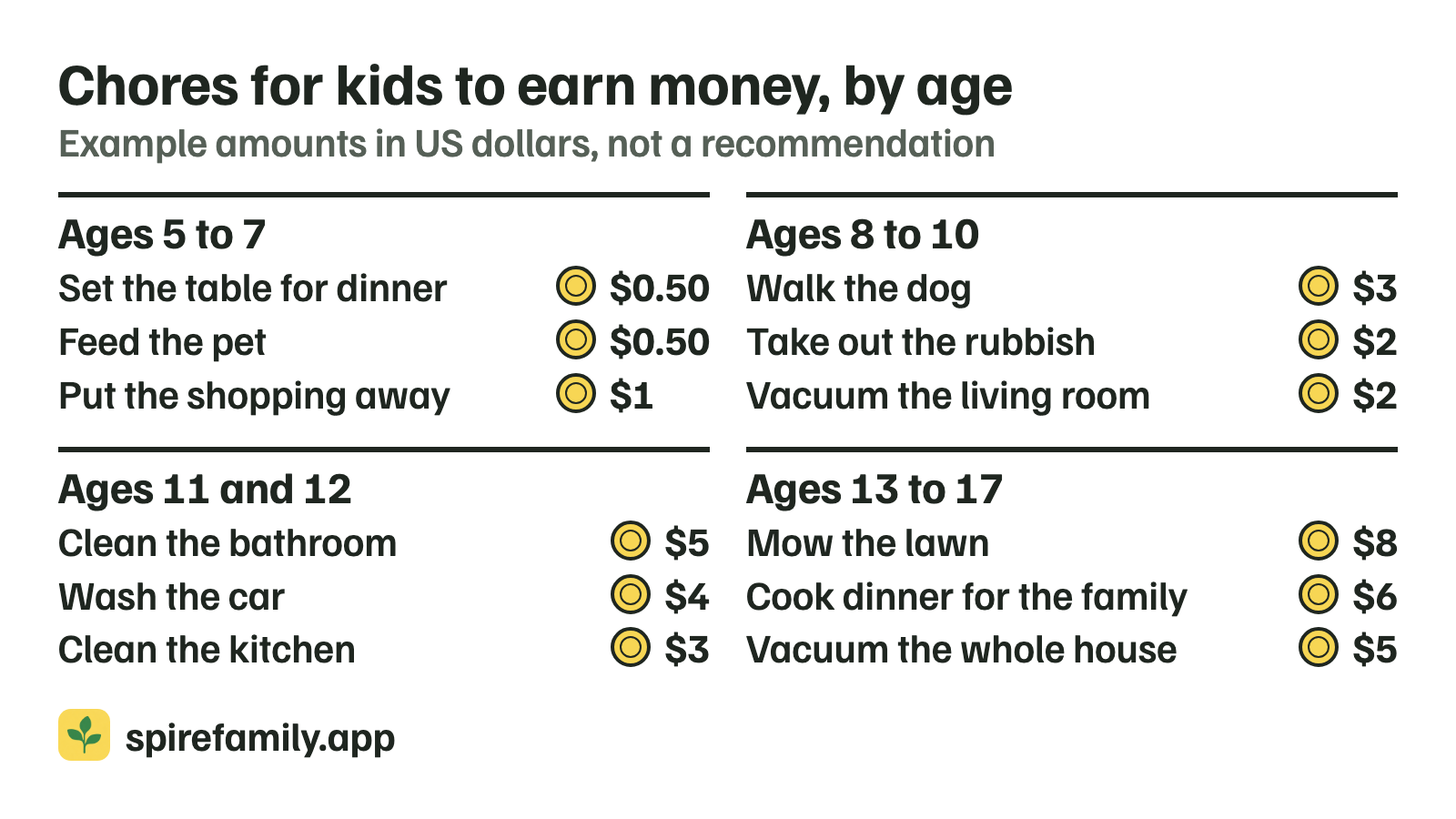
What chores should kids get paid for?
Make two lists with your children. The first is what everyone helps with because they live there, such as making your bed and packing your school bag. Nobody is paid for these. The second is paid jobs: work that is useful to others in the family and that an adult would otherwise have to do, such as cleaning the bathroom or walking the dog. The guide to paying kids for chores explains how the money can then be split between Save, Spend and Give.
Families draw the line in different places. In an Irish survey of more than 800 parents for the Teachers' Union of Ireland Credit Union in 2024, 86% of those who gave pocket money said children should earn it by doing household chores (Osborne, 2024). Raising Children Network, an Australian parenting site, writes that there are no rights and wrongs about paying for chores, and that some families pay extra pocket money for extra chores. Write your line down, so it is the same next month.
Pocket money jobs for 5 to 7-year-olds
Small jobs that take a few minutes. Do each job together the first few times, until your child can do it alone.
| Job | Example amount |
|---|---|
| Set the table for dinner | $0.50 |
| Water the plants | $0.50 |
| Feed the pet | $0.50 |
| Empty the bins in each room | $1 |
| Sort the clean laundry | $1 |
| Put the shopping away | $1 |
| Sweep the kitchen floor | $1 |
Pocket money jobs for 8 to 10-year-olds
Jobs that take longer, done alone once your child knows how.
| Job | Example amount |
|---|---|
| Walk the dog | $3 |
| Take out the rubbish | $2 |
| Vacuum the living room | $2 |
| Help cook dinner | $2 |
| Hang out the washing | $1.50 |
| Empty the dishwasher | $1 |
| Wipe the kitchen counters | $1 |
Pocket money jobs for 11 and 12-year-olds
Bigger jobs, where it helps to agree what "done" means. For the bathroom, that might be the basin, the toilet and the floor. The American Academy of Pediatrics lists cooking with supervision, and looking after a younger sibling with an adult at home, for this age.
| Job | Example amount |
|---|---|
| Clean the bathroom | $5 |
| Wash the car | $4 |
| Make lunch for everyone | $3 |
| Clean the kitchen | $3 |
| Look after a younger sibling | $3 an hour |
| Change the beds | $2 |
| Do a load of washing | $2 |
Pocket money jobs for 13 to 17-year-olds
The biggest jobs on the list. Teenagers can also take over jobs from the younger lists (Flais, 2024) and be responsible for them on their own.
| Job | Example amount |
|---|---|
| Mow the lawn | $8 |
| Cook dinner for the family | $6 |
| Vacuum the whole house | $5 |
| Weed the garden | $5 |
| Do the grocery shopping | $4 |
| Wash the dog | $4 |
How to set the amount for each job
Start with time. Setting the table takes a few minutes and earns $0.50 in the list. Mowing the lawn takes much longer and earns $8. Then look at how hard the job is: cleaning the bathroom earns more than vacuuming the living room, because it is a dirtier job. Last, ask who the job helps. Tidying your own room helps you, so it stays unpaid. Vacuuming the living room helps everyone, so it is paid.
Ireland's Competition and Consumer Protection Commission (CCPC) compares earning pocket money to a job: the more children do, the more they earn. Your child can suggest an amount, and an adult decides. Agree the amount before your child starts, and say what the job includes. Raising Children Network gives the reason: then there is no confusion or bargaining about it later. Choose amounts you can keep paying for a year.
As a reference point, a survey of 1,007 Australian parents for Westpac in 2025 found that 55% of children aged 8 to 17 earned pocket money for chores at home. Parents who gave pocket money gave an average of A$25 a week.
Jobs kids suggest themselves
A child who wants to earn more can suggest a job and what they think it is worth. Raising Children Network writes that children over 6 can have a say in which chores they do. An adult decides whether the suggestion becomes a paid job and sets the amount before the work starts.
If the suggestion is on the first list, such as tidying their own room, it stays unpaid. If it saves someone else the work, such as raking leaves or sorting the recycling, add it to your list with the amount, so it is the same next time.
A printable chores list for kids to earn money
The list for the fridge has all 27 jobs with the example amounts, a column for the amount your family agrees on, and empty lines for jobs you add yourselves.
Common questions
How can kids earn money at home?
By doing paid jobs that save someone else in the family the work, such as walking the dog or washing the car. Agree the job and the amount first, and pay when an adult has checked that it is done.
How much should I pay my kids for chores?
In the example list, from $0.50 for setting the table to $8 for mowing the lawn. Pay more for jobs that take longer or are harder, and choose amounts you can keep paying.
When should you start paying kids for chores?
Children who can count money can take part. The list starts at age 5, with small jobs and small amounts. In the Irish survey from 2024, parents who gave pocket money started when their child was nine, on average.
How much should I pay my kid to mow the lawn?
$8 in the example list, for teenagers. The American Academy of Pediatrics recommends that children are at least 12 before they use a walk-behind power mower and at least 16 before they use a ride-on mower, and that an adult shows them how first.
What if my child only wants to do the paid jobs?
The first list still applies. Making your bed and putting your plate in the dishwasher are done whether or not anyone takes a paid job that week.
Spire keeps track of the paid jobs
Spire is an app for iPhone and iPad for the second list. A parent adds each job with its reward, which children can do it and how often. The child marks a job as done on their own iPhone or iPad, or a parent records it, and the money is recorded when a parent approves it. When the pot reaches the amount you have chosen, it is divided between Save, Spend and Give. Children can suggest jobs, and a grown-up sets the reward. Every job in Spire has a reward, so what everyone helps with stays on paper. Spire does not hold or move money. Prices and countries are on the fact page.

Sources
Read on 19 November 2026.
- American Academy of Pediatrics (2024). Age-Appropriate Chores for Children. HealthyChildren.org. https://www.healthychildren.org/English/family-life/family-dynamics/communication-discipline/Pages/Chores-and-Responsibility.aspx
- Flais, S. V. (2024). Household Chores for Teens. American Academy of Pediatrics, HealthyChildren.org. https://www.healthychildren.org/English/family-life/family-dynamics/Pages/Household-Chores-for-Adolescents.aspx
- American Academy of Pediatrics (2025). Lawn Mower Safety: Information for Families. HealthyChildren.org. https://www.healthychildren.org/English/safety-prevention/at-home/Pages/Lawnmower-Safety.aspx
- Raising Children Network (2025). Household chores for kids. https://raisingchildren.net.au/preschoolers/family-life/routines-rituals-rules/chores-for-children
- Raising Children Network (2025). Pocket money: when & how much? https://raisingchildren.net.au/preschoolers/family-life/pocket-money/pocket-money
- Competition and Consumer Protection Commission. Parents Hub: How to teach children about money. https://www.ccpc.ie/manage-your-money/financial-education-resources/parents-hub
- Westpac (2025). Kids earning more pocket money than their parents did. Media release, 28 September 2025, on the 2025 Westpac Youth Pocket Money Report by Lonergan Research. https://www.westpac.com.au/about-westpac/media/media-releases/2025/28-september/
- Osborne, E. (2024). Nearly 50% parents give their children pocket money. BreakingNews.ie, 30 October 2024, on a survey for the Teachers' Union of Ireland Credit Union. https://www.breakingnews.ie/ireland/nearly-one-in-two-parents-give-their-children-pocket-money-tuicu-1688801.html
Last updated 19 November 2026